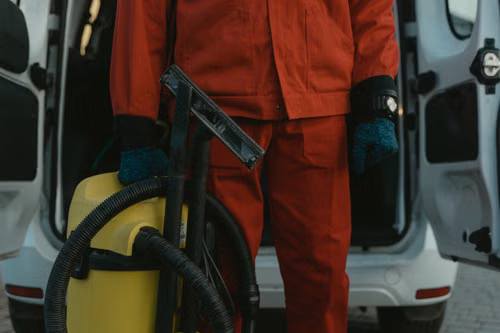
Here is a strange fact about a flooded room. The same gallon of water has three different prices, and the price depends entirely on when you remove it. While it sits on the floor as liquid, it is cheap to handle, almost trivially cheap. Once it soaks into carpet pad, drywall, and framing, the price climbs. And once it turns to vapor inside your walls, feeding humidity and giving mold what it needs, that gallon becomes the most expensive water in the house. Water extraction services exist to catch gallons at the first price, and the whole job is a race against the other two.
The distinction sounds technical, but it decides your bill. Water extraction services pull liquid water out of a building mechanically, with pumps and extractors, in hours. Drying removes what is left the slow way, coaxing moisture out of materials as vapor over days of equipment time. Every gallon that leaves through a hose is a gallon that never has to leave through the air.
Storm flooding and basement water are regular problems around Lafayette, and the same race plays out from older basements to newer homes. Restoration Logistics Lafayette runs that race with a 60-minute response window, because the crews have seen what the second and third prices look like on an invoice. Speed here is not a sales line; it is the actual cost control.
The Same Gallon of Water at Three Different Prices
Price one is standing water. A pump or extractor moves it quickly by the gallon, and the main costs are a crew and a few hours. Price two is absorbed water. Now the gallon lives inside carpet pad, subfloor, and the bottom two feet of your drywall, and removing it takes air movers, dehumidifiers, and daily monitoring visits across several days.
Price three is the gallon you never removed in time. It fed the humidity that condensed somewhere new, or it kept a wall cavity damp past the window where mold takes hold. That gallon stops being a water problem and becomes a demolition and remediation problem. It is the same water with wildly different outcomes, and the only variable that changed was time.
The Physics Bill: Why Vapor Always Costs More Than Liquid
There is real science behind the price jump, and it is worth two minutes. Turning liquid water into vapor takes a startling amount of energy. The U.S. Geological Survey puts the heat of vaporization at 540 calories per gram, roughly seven times the energy involved in melting ice. The U.S. Army Corps of Engineers makes the same point in its hydrology guidance, noting that evaporation involves large quantities of energy.
A pump ignores all of that. It moves water as water, no phase change required, which is why one machine can empty in an afternoon what evaporation would need days and a wall of equipment to release. When a crew pushes to extract instead of settling for drying, they are not being impatient. They are refusing to pay nature’s least favorable exchange rate.
What Water Extraction Services Actually Do in the Liquid Window
The liquid window is short, so the work inside it is deliberate. Crews start with the deepest standing water and move outward, then switch to weighted extraction on carpet, pressing water up out of the pad instead of skimming the surface. The same area gets worked in repeated passes, because carpet releases water reluctantly and one quick pass leaves most of it behind.
You can watch the recovery tank fill and see the argument in physical form. Every gallon in that tank skipped the drying phase entirely. It will never run a dehumidifier, never extend the equipment time, never show up in a moisture reading on day four. Honestly, it is the only part of a flood that feels like winning.
When the Liquid Window Closes, the Meter Takes Over
Materials do not wait politely. Carpet pad drinks water in minutes, drywall wicks it upward within hours, and subfloor takes it in and holds on. Once absorption wins, extraction gives way to drying, and the job shifts from gallons per minute to readings per day.
This is the stretch homeowners underestimate. The room looks damp rather than flooded, so the danger feels over, but the remaining water now leaves at the pace of evaporation and equipment. The delay you spent finding towels or waiting until morning did not shrink the water. It just moved gallons from the cheap column into the slow one.
What This Means for Your Basement and Your Bill
The practical conclusions are short and worth keeping somewhere you will find them wet-handed:
- Call while the water is still liquid, even at a bad hour, because the first price expires fast.
- Stop the source if you can reach the shutoff safely, since every new gallon enters at price one.
- Do not push water toward drains through finished rooms, which spreads it into dry materials.
- Expect professional crews to extract aggressively before setting drying equipment, and ask about it if they skip straight to fans.
- Keep in mind that a fast extraction usually means fewer drying days, less equipment in your house, and a smaller disruption overall.
There is perhaps one consolation in all of this. The race is winnable, and the finish line comes early. A basement extracted within a few hours often needs a fraction of the drying time of one that waited a day, and the difference shows up everywhere, in the timeline, in the noise, in the bill.
So if water is on your floor right now, it is sitting at the lowest price it will ever offer you. Take it. Call for extraction while the gallons are still gallons, and let the pumps do in an afternoon what vapor would stretch across your whole week.