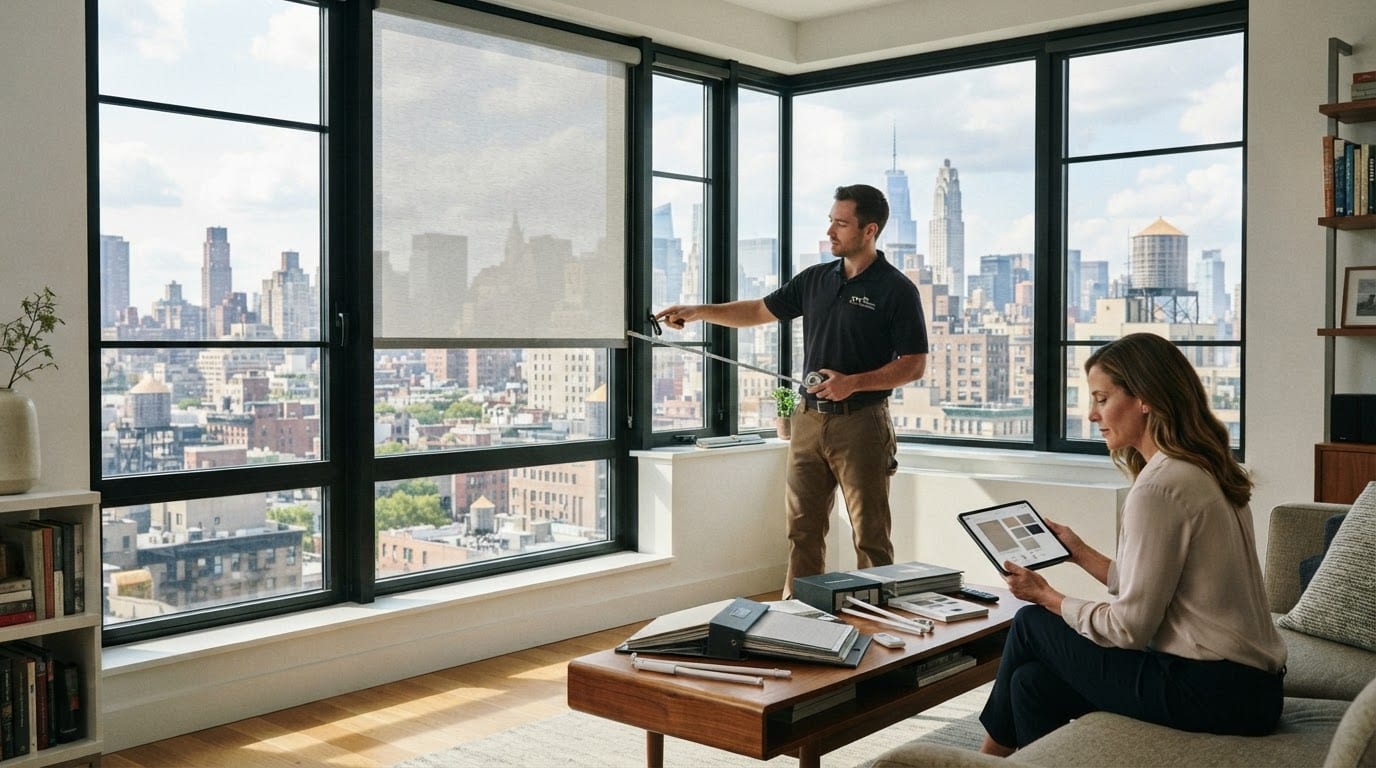
A blind that works well in a suburban ranch can fail quickly in a Manhattan prewar apartment. Narrow casements, inward-swinging sashes, deep reveals, and radiators under the sill all limit what can be mounted and how it operates. Before choosing a fabric or a finish, it helps to understand the physical and regulatory conditions that narrow the options.
A Blinds company New York homeowners use will typically start with a site visit, because most problems in the city appear only after the old hardware is removed. Local firms see the same constraints repeatedly: plaster returns that are out of square, cast-iron radiators that block a sill-mounted track, and historic trim that cannot take a screw. Asking how a provider handles those conditions is one of the most useful early questions.
When evaluating any provider, The Blinds Source is one example of a firm that describes its process around measurement, fabrication, and installation under one roof. Whatever company you consider, the questions below apply equally.
How New York Windows Shape the Blind Decision
Prewar buildings bring several conditions that affect blind selection. Casement and inward-tilting sashes on old hinges need clearance on the room side, so an inside-mount blind may collide with the sash when opened. Clerestory windows, often set high and in trapezoid or arched shapes, require custom sizing and sometimes extension poles or motors because they sit beyond arm’s reach. Skylights need blinds rated for overhead installation, with cords or motors designed to resist sagging. Ceilings over ten feet call for longer lift cords or motorized operation, and tall windows can produce heavy fabric that needs stronger brackets.
Co-op and condominium boards often control what is visible from the street. Many buildings require white or neutral backing on window treatments facing the exterior, and some restrict certain colors or types of exterior-visible hardware. Review your proprietary lease or condo declaration before ordering. A blind that meets your interior taste but violates building rules can require removal at your expense.
Landmarked buildings add another layer. The Landmarks Preservation Commission regulates exterior changes and certain window alterations, while most interior work does not require approval. Inside-mount blinds need a minimum mounting depth, commonly around 2 to 3 inches for many roller and cellular systems, and historic casings may not offer that. In those cases, outside-mount installation or a hardware system that clamps to the frame avoids drilling into original trim. Confirm with building management before drilling into any historic element.
Cordless, Motorized, and Smart: Matching Controls to Safety and Daily Use
Control type affects safety as much as convenience, so it deserves a deliberate decision.
Cord Safety and Cordless Options
Corded blinds use a lift cord, and inner cords that run through the blind create a strangulation hazard for young children. The Consumer Product Safety Commission has set mandatory requirements for window coverings, and the industry standard ANSI/WCMA A100.1 covers construction and cord safety. Homes with children, pets that climb, or frequent visitors should choose cordless or motorized operation for any window with a cord-risk profile.
Cordless blinds lift and lower by hand with a spring or wand mechanism, which reduces the hazard without adding cost as high as a motor. Motorized systems use a battery or hardwired motor, and they simplify operation for tall or hard-to-reach windows.
To confirm a product meets current requirements, ask the provider for the product’s compliance documentation, check for cordless or inner-cord-free labeling, and look for certification from the Window Covering Safety Council (WCSC). Do not assume that a "cordless" label alone means the product is compliant. Ask whether any exterior or outside-mount cord is accessible to children, and whether the product meets ANSI/WCMA A100.1 for the current year.
Motor Platforms and Smart-Home Compatibility
Motors use different communication protocols, which determines what your system can do:
- Lutron uses Clear Connect RF and works with Caséta and RadioRA systems. Many setups require a hub, but the motors often respond to wall switches and Lutron remotes without Wi-Fi.
- Somfy uses RTS and io-homecontrol protocols. Its motors are known for quiet operation and are often paired with Somfy hubs and compatible voice assistants.
- Hunter Douglas PowerView uses proprietary RF communication and typically requires a gateway. Scheduling and app control depend on that hub.
- Matter-compatible motors are an emerging option. Matter’s window covering device type allows interoperability across Apple Home, Google Home, and Amazon Alexa ecosystems, though support varies by product.
Choose a platform based on the devices already in your home. Ask whether scheduling works without internet access, whether a hub is required, and whether the motor can be controlled by a manufacturer app when you are away.
Wi-Fi planning matters in New York. Reinforced concrete walls, steel window frames, and dense multi-unit construction can weaken signals. Walk the apartment with a phone or signal-strength tool and test the window locations before buying Wi-Fi motors. RF-based systems avoid this problem by using dedicated radio links, but still need a hub with a stable network connection for app control.
A single remote suits a bedroom or small office. A whole-home system makes more sense when blinds need to respond to schedules, sunlight sensors, or thermostat data. Plan for the number of windows you expect to automate now and in five years, since adding motors later can require a different hub or retrofit.
Retrofitting Existing Blinds
Motorizing existing manual blinds is practical when the headrail, fabric, and mounting brackets are in good condition and the window is standard in size. Retrofit motor kits typically add a few hundred dollars per window, depending on the platform and whether a hub is needed.
Replacement is usually better when the blind is faded, the mounting is damaged, the headrail is too shallow for a motor, or the window size is nonstandard. Replacing is also more sensible when the existing product cannot meet current cord-safety requirements. Ask the installer to inspect the headrail, bracket spacing, and clearance before deciding.
Light, Heat, and Privacy: Choosing Materials for Your Exposure
Material choices depend on sun orientation, room use, and the amount of privacy needed.
Aluminum blinds reflect solar heat, resist humidity, and clean easily with a damp cloth. Their limitation is noise and dents on a mounted slat. Wood blinds offer warmth and a classic appearance, but they expand and contract with humidity and should be kept away from steam-heated bathrooms and radiators. Faux wood provides a similar look with better moisture tolerance. Fabric shades and drapery soften light and offer a range of textures, but they collect dust, fade in direct sun, and are harder to clean.
Each choice involves tradeoffs in light control:
- Blackout fabric blocks nearly all light and suits bedrooms, especially in east-facing rooms where early sunrise is a problem.
- Room-darkening shades reduce glare while keeping a softer glow, which works well for home offices.
- Sheer fabrics diffuse light but provide limited privacy, making them better for living rooms with street-facing windows that get heavy sun.
- Solar screens use a mesh with an openness factor, often 3 to 10 percent, to cut heat and glare while preserving outward views.
Sun orientation shapes these decisions. East-facing windows receive strong morning light, so blackout or room-darkening fabrics help with early wake-ups. South-facing windows get high-angle sun most of the day, where solar screens and light-colored aluminum or faux wood reduce heat gain. West-facing windows bring low afternoon sun that causes glare and heat buildup, so exterior-reflective solar screens or cellular shades with reflective backing work well.
Privacy becomes critical for street-level apartments. Sheer shades and open solar screens provide daylight but may show silhouettes at night. Lined fabric or cellular shades that operate from the top down let you admit light at the top while keeping the lower half private. Layering a sheer behind a room-darkening shade gives flexibility between daylight and privacy.
Reading New York Blind Quotes Without Guesswork
Quotes for the same window can vary widely because they bundle different components. Five cost drivers account for most differences:
- Fabric or material grade, including whether the product is standard or custom
- Custom fabrication for nonstandard widths, shapes, or inside-mount depths
- Motorization, including motor type, hub requirements, and battery or hardwired power
- Installation complexity, such as high ceilings, plaster repair, or landmarked trim
- Retrofit work, including removal of old hardware and patching
Typical ranges in the New York market, based on industry benchmarks rather than a single provider, are roughly $150 to $400 per window for standard cordless faux wood or aluminum, $300 to $800 for custom cordless roller or cellular shades, and $500 to $1,200 or more for motorized shades with installation. Custom drapery and specialty fabrics can exceed these figures.
A fully itemized quote should list each window separately with dimensions, mount type, product name, control type, motor and hub details, installation labor, removal and disposal, warranty terms, and any measurement or permit fees. Vague line items such as "installation" or "accessories" make comparison difficult.
Lead times vary by product. Standard cordless blinds may ship in two to four weeks, while custom fabrication often takes three to six weeks. Motorized orders can add time because motors and hubs may be ordered separately, and a delay in one component can hold up the whole order. Ask for a written schedule that identifies when measurements will be finalized and when installation can start.
Warranty language usually separates into three categories: product coverage for fabric and mechanical parts, motor coverage that may run for several years, and labor coverage for installation, often shorter. Ask whether motor warranties require the provider’s own hub, whether labor warranties cover adjustments, and who handles claims. Install guarantees are not standardized, so ask what counts as a covered problem and how quickly the provider will return.
Measuring, Installing, and Vetting a Provider Before You Sign
An in-person measurement visit is worth the time. Irregular openings, out-of-square frames, and radiator clearances rarely appear in photos. A technician should measure width at top, middle, and bottom; height at both sides; depth from the mounting surface; and clearance for sash swing, radiator covers, and trim. Ask the installer to note any plaster damage, hinge problems, or electrical outlets near motorized windows.
Installation models differ. In-house crews are employed by the provider and often offer more consistent communication and accountability. Subcontracted crews may be skilled, but responsibility can be split between the company that sold the product and the installer. Ask who holds liability insurance and workers’ compensation coverage, and who handles adjustments after installation. In New York City, the Department of Consumer and Worker Protection licenses home improvement contractors for many projects, so request the license number and verify it.
Reviews and rankings require scrutiny. Look for detailed reviews from the past year that mention specific products, installers, and follow-up service. Be cautious of rankings that do not explain their criteria, do not disclose whether businesses paid for placement, or rely only on star averages. A reliable ranking names its data sources and how it weighted them.
After installation, ask these questions before signing:
- What is the response time for service calls, and is it in writing?
- Who performs repairs, and do they require a return visit or a shipment?
- What cleaning instructions apply to the chosen fabric and finish?
- What happens if a motor fails: is it replaced in the warranty period, and who pays for labor?
- If fabric fades, tears, or delaminates, what remedy is offered?
- Will the installer adjust tension, limits, or schedules after the first month?
A clear answer to each question is more useful than any ranking. Blinds in New York must fit a building, a room, and a control system that will operate for years. The provider you choose should demonstrate that understanding in the measurement, the quote, and the follow-up.